Electrical Engineering Program
Head of Electrical Engineering Department Word
The Department of Electrical Engineering at the College of Engineering at King Faisal University has witnessed a large development plan since the establishment of the College of Engineering, in line with the strategic plans towards directing the goals of social development and the promising KSA Vision 2030 at the national and university levels. The Department of Electrical Engineering has since ensured creation of a creative scientific environment utilizing innovative and modern research methods that are compatible with the requirements of the labour market and meet the needs of its male and female students and faculty members. In continuation of the efforts of the leadership of the department, the Department of Electrical Engineering witnessed several development milestones one of which is obtaining the international academic accreditation (ABET) in 2015 until the present time, in addition to enrolling female students and establishing the Master of Science in Electrical Engineering program in 2021. The Department of Electrical Engineering has contributed to continuing to develop over the years; moving forward by employing national/international education standards and contributing to industrial national projects and initiatives related to Vision 2030 by improving distinguished graduates in learning and improving graduates at all levels. One of our most important goals is to ensure that our graduates acquire basic skills and be able to obtain professional certification and provide engineering training opportunities with specialized entities in the industry besides and guaranteeing the quality of their educational attainment. The Department of Electrical Engineering is currently following a strategic plan based on the current institutional identity of King Faisal University entitled “Food Security and Environmental Sustainability”. The Department has distinguished and influential faculty members with their research, experience, and patents on various electrical engineering branches including Renewable Energy, Communications Systems, Electrical Power Systems, Wireless Communication Systems, Control Systems, Smart Grids, and others. The Department of Electrical Engineering is employing engineering sciences and scientific research intending to activate such expertise through collaborations and industrial projects in cooperation with academic activities and various industries, one of which recently is the national project to standardize chargers for mobile phones and electrical devices with the Saudi Standards and Metrology Organization. The Department also has many memorandums with many reliable bodies in the governmental and industrial sectors, including the Saudi Electricity Company, Honeywell, King Abdullah City for Atomic and Renewable Energy (K.A.CARE), and other entities. We will continue to develop to the highest levels of standards in ensuring the quality of graduates, learning outcomes, and quality of research to continue towards building an academic and scientific community that our beloved homeland will rely on in building the future.
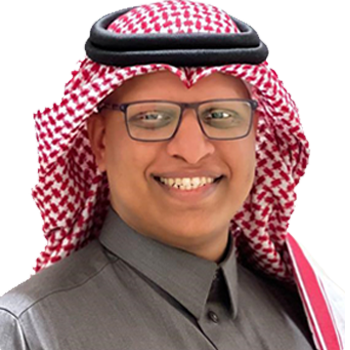

Dr. Mohammed A. AlAqil
Head of Electrical Engineering Department
About the Program
The Electrical Engineering Department is committed, through close partnership with the community, to providing quality education that prepares graduates through a project-based learning to be professionals and to pursue graduate studies and research. The department is also committed to research that leads to better solutions to electrical engineering-related problems with emphasis on issues of national significance by working closely with industry and research centers.
Within a few years of graduation, Electrical Engineering graduates are expected to attain the following program educational objectives:
- PEO 1 : Graduates will apply their knowledge and skills to lead a successful career in Electrical Engineering and advance to the position of leadership in their profession.
- PEO 2 : Graduates will demonstrate effective communication and teamwork skills and recognize ethical and professional responsibilities in a diverse work environment.
- PEO 3 : Graduates will pursue their professional development through continuous self-learning, research work, and graduate studies.
These are the same outcomes as articulated by ABET and are listed below:
- Ability to identify, formulate, and solve complex engineering problems by applying principles of engineering, science, and mathematics
- Ability to apply engineering design to produce solutions that meet specified needs with consideration of public health, safety, and welfare, as well as global, cultural, social, environmental, and economic factors
- Ability to communicate effectively with a range of audiences
- Ability to recognize ethical and professional responsibilities in engineering situations and make informed judgments, which must consider the impact of engineering solutions in global, economic, environmental, and societal contexts
- Ability to function effectively on a team whose members together provide leadership, create a collaborative and inclusive environment, establish goals, plan tasks, and meet objectives
- Ability to develop and conduct appropriate experimentation, analyze and interpret data, and use engineering judgment to draw conclusions
- Ability to acquire and apply new knowledge as needed, using appropriate learning strategies
Interaction with Industry
التفاعل مع الشركات والقطاعات الصناعية
Right from the start, the College of Engineering at King Faisal University has chosen to involve its stakeholders in decision making. The College has arranged numerous meetings and workshops with industry representatives and community leaders. The College believes that representatives feedback and input is a valuable source for building and sustaining success and competitiveness in our graduates and thus is keen to maintain continuous contacts with them. To establish for an institutionalized mechanism of interaction with the industry, the EE program has a list of representatives who enjoy sufficient experiences to provide advice to the program faculty and staff on various aspects including academic issues, cooperative efforts with industry, and strategic planning. They also have the capacity to bring to the program the latest concerns and challenges facing industry to assist and guide the program in preparing graduates for their future careers.
The following list of individuals includes the current representatives for the EE program:
Curriculum
Alumni
Electrical Engineering Alumni
Brochure
Faculty & Staff

Dr. Mounir Bouzguenda
Associate Professor
Dr. Adel Sharar Aldalbahi
Associate Professor
Dr. Mohammed Morsy Farag
Associate Professor
Dr. Mohammed Khalid Alarfaj
Assistant Professor
Dr. Ahmed S. Alsafran
Assistant Professor
Dr. Abdullah Saad Bubshait
Assistant Professor
Dr. Hesham Mohammed Enshasy
Assistant Professor
Dr. Mohammed A. AlAqil
Assistant Professor
Dr. Mohammed Al-Shakhs
Assistant Professor
Dr. Mohammed Ahmed Hassan
Assistant Professor
Dr. Nayef Mohammed Alqahtani
Assistant Professor

Master in Electrical Engineering
1- About Program:
Established in 2021, the Master in Electrical Engineering program at the Department of Electrical Engineering, College of Engineering, King Faisal University holds the distinction of being the first postgraduate program in the College of Engineering.
The program is designed to prepare highly qualified engineers and researchers with advanced knowledge, technical expertise, and research capabilities in the rapidly evolving field of electrical engineering. It provides an advanced academic environment that combines theoretical knowledge with practical applications, enabling students to address contemporary engineering challenges and contribute to the development of innovative and sustainable technological solutions.
Through advanced coursework, research activities, and specialized projects, students develop strong analytical, problem-solving, and research skills. The program is aligned with the evolving needs of industry, the energy sector, and emerging technologies, supporting the development of qualified professionals capable of contributing to the Kingdom’s technological advancement and the objectives of Saudi Vision 2030.
Graduates of the program are well prepared to pursue careers in industry, research and development, academia, and other specialized engineering sectors, as well as to continue their studies at the doctoral level.
Program Highlights:
- Established in 2021 as the first postgraduate program in the College of Engineering.
- Advanced education and research in key areas of electrical engineering.
- Opportunities to engage in innovative research and applied engineering projects.
- Development of advanced analytical, technical, and problem-solving skills.
- Preparation for professional and leadership roles in industry, research, and academia.
- Alignment with national priorities, emerging technologies, and sustainable development.
2- Program Mission:
The program mission is to provide its graduates with top quality education in the field of electrical engineering and preparing them to practice their professions competently to meet the ever-changing needs of society.
Excellence and diversity in research are essential to the mission and built on the strong collaboration with the industry and government funding organizations.
3- Program Objectives/Goals:
- To create new opportunities for graduate education in the kingdom and help prepare engineering graduates to assume leadership roles in academic research as well as in industry.
- To enhance research and development in the Kingdom and open a new window of collaborations with academic institutes and industry in the Kingdom.
- To train a pool of knowledgeable specialists who will be able to contribute positively to solving current and future problems of society.
- To provide opportunities for continuing professional development for practicing engineers and applied scientists.
4- Program Learning Outcomes:
| Program Learning Outcomes | Code | Learning Outcome |
|---|---|---|
| Knowledge and Understanding | ||
| K1 | Master the knowledge of electrical engineering concepts. | |
| Skills | ||
| S1 | Conduct theoretical and practical research independently and collaboratively. | |
| S2 | Formulate complex engineering problems and plan a procedure for solution. | |
| Values, Autonomy, and Responsibility | ||
| V1 | Communicate, organize and present information effectively. | |
| V2 | Realize the relevance of economics, ethics and teamwork to the profession. | |
| V3 | Pursue advanced graduate studies and lifelong learning. | |
5- Admission and Registration:
Admission
The Graduate Studies announces the opening of admission of all postgraduate programs at KFU. The department handles admissions with colleges setting program-specific requirements and quotas. The process is strictly regulated with no exceptions. All applicants must apply online through the postgraduate portal, including international candidates. Then, the postgraduate department verifies the eligibility of all applicants. Afterwards, all eligible applicants are sent to the EE Department to review and proceed with the admission process.
In addition to meeting the university’s general requirements for admission to graduate studies, applicants must hold academically equivalent credentials to a Bachelor’s degree in Electrical Engineering from King Faisal University or from other accredited universities recognized by the Ministry of Education in the Kingdom of Saudi Arabia. These admission requirements for Master in EE are approved by department council as follows:
- A minimum cumulative GPA of 3.75/5 (or equivalent) in the Bachelor's degree.
- Since English is the language of instruction in engineering, applicants must provide proof of proficiency sufficient to pursue studies in English: an overall IELTS score of 5.5 (Academic module), or an equivalent score on TOEFL.
Other supporting documents are required to be included in the application:
- Two reference letters from academic staff at the university from which the Bachelor's degree was obtained (e.g., former instructors).
- A complete academic transcript: each transcript must include its grading scale.
The selection process starts with reviewing all applicants by the admission committee. Applicants who satisfy the minimum requirements are listed and shared with the EE department to be discussed and approved by the Department Council.
Registration
Registration follows the published add/drop windows by the department of Graduate Studies. Students receive program study plans and track options (Thesis-based and Project-based) and showing graduation requirements for each track. Each student is assigned an academic advisor to monitor progress and provide guidance for course selections. Exceptions to registration can be facilitated through standardized and approved forms with clear approval pathways to ensure equity in exception handling. The university issues an annual academic calendar for postgraduate programs with registration deadlines. The calendar includes all registration events such as early registration, confirmation of registration, and addition or removal of course registrations, starting and ending of semester as well as payment deadline.
The Graduate Studies Programs Administration provided a comprehensive guide covering all essential academic processes for both semesters and advanced students. It explains how to update your password, pay tuition fees, upload the payment receipt or a successful electronic transfer confirmation through the Graduate Studies Portal, and register courses in the Banner system.
6- Study Plan:
| Level | Course Code | Course Title | Required or Elective | Prerequisite Courses | Credit Hours | Type of Requirements (Institution, College, or Program) |
|---|---|---|---|---|---|---|
| 1 | 2202-502 | Advanced Engineering Mathematics | Required | MATH215 | 3 | Program |
| 2202-519 | Renewable and Sustainable Energy Systems | Required | None | 3 | Program | |
| 2202-533 | Communication Systems I | Required | 2202-332 | 3 | Program | |
| 2202-550 | Linear Systems Theory and Design | Required | 2202-430 | 3 | Program | |
| 2202-570 | Advanced Electronics | Required | 2202-243 2202-231 |
3 | Program | |
| 2 | 2202-501 | Advanced Engineering Electromagnetic | Elective | 2202-331 | 3 | Program |
| 2202-513 | Power System Operation and Control | Elective | 2202-481 | 3 | Program | |
| 2202-518 | Advanced Power Electronics | Elective | 2202-482 | 3 | Program | |
| 2202-531 | Random Signal Analysis I | Elective | 2202-332 | 3 | Program | |
| 2202-554 | Robotics I | Elective | 2202-429 2202-430 |
3 | Program | |
| 2202-573 | Semiconductor Manufacturing Technology | Elective | 2202-570 | 3 | Program | |
| 2202-575 | Lasers and Electro-Optics | Elective | None | 3 | Program | |
| 3 | 2202-520 | Special Topics in EE | Elective | None | 3 | Program |
| 2202-532 | Information Theory | Elective | None | 3 | Program | |
| 2202-551 | Optimal Control Theory | Elective | 2202-430 | 3 | Program | |
| 2202-557 | Nonlinear Systems | Elective | 2202-430 | 3 | Program | |
| 2202-572 | Optoelectronics | Elective | 2202-243 2202-331 2202-493 |
3 | Program | |
| XXXX-xx | MS course from other department or college | Elective | — | 3 | — | |
| 4 | 2202-588 | Project | Required | — | 6 | Program |
| 2202-599 | Thesis | Required | — | 6 | Program |
7- Syllabus
| S. No. | Course Code | Course Title | Link to CS |
|---|---|---|---|
| 1 | 2202-502 | Advanced Engineering Mathematics |
|
| 2 | 2202-519 | Renewable and Sustainable Energy Systems |
|
| 3 | 2202-533 | Communication Systems I |
|
| 4 | 2202-550 | Linear Systems Theory and Design |
|
| 5 | 2202-570 | Advanced Electronics |
|
| 6 | 2202-501 | Advanced Engineering Electromagnetic |
|
| 7 | 2202-513 | Power System Operation and Control |
|
| 8 | 2202-518 | Advanced Power Electronics |
|
| 9 | 2202-531 | Random Signal Analysis I |
|
| 10 | 2202-554 | Robotics I |
|
| 11 | 2202-573 | Semiconductor Manufacturing Technology |
|
| 12 | 2202-575 | Lasers and Electro-Optics |
|
| 13 | 2202-520 | Special Topics in EE |
|
| 14 | 2202-532 | Information Theory |
|
| 15 | 2202-551 | Optimal Control Theory |
|
| 16 | 2202-557 | Nonlinear Systems |
|
| 17 | 2202-572 | Optoelectronics |
|
| 18 | 2202-588 | Project |
|
| 19 | 2202-599 | Thesis |
|
8- Faculty Details:
| Rank | Female | Male | Total |
|---|---|---|---|
| Professor | 0 | 1 | 1 |
| Associate Professor | 1 | 8 | 9 |
| Assistant Professor | 5 | 9 | 14 |
| Total | 6 | 18 | 24 |
| Teaching Staff | Saudi | Non-Saudi |
Average Teaching Load For All Teaching Staff |
|||||||
|---|---|---|---|---|---|---|---|---|---|---|
| Male | Female | Total | Male | Female | Total | Male | Female | Total | ||
|
No. of Ph.D. Holders |
Professor | 0 | 0 | 0 | 1 | 0 | 1 | 6 | 0 | 6 |
|
Associate Prof. |
4 | 0 | 4 | 4 | 1 | 5 | 10 | 10 | 20 | |
|
Assistant Prof. |
3 | 0 | 3 | 6 | 5 | 11 | 12 | 12 | 24 | |
| Total | 7 | 0 | 7 | 11 | 6 | 17 | 28 | 22 | 50 | |
9- Basic Statistics:
10- Program Achievements:
- Publishing Peer reviewed Scientific Journal Papers in well-known databases (IEEE, CIGRE, Elsevier).
- Participation in various conferences and symposiums.
- Best conference paper award. View
11- Alumni Info:
Contact Us:
| Postgraduate Program Follow Up Committee | Phone No. | Office No. | |
|---|---|---|---|
| Dr. Abdullah Saad Bubshait | asbubshait@kfu.edu.sa | +966 13 589 5440 | 2122 |
| Dr. Ehab S. Awad Mohamed | esmohamed@kfu.edu.sa | +966 13 589 5621 | 2121 |
| Dr. Tarek Moustafa Said Moawad | tsaid@kfu.edu.sa | — | 2119 |
| Dr. Mohammed Morsy Farag | mfarag@kfu.edu.sa | +966 13 589 9294 | 2114 |
| Dr. Shima Sadaf | ssadaf@kfu.edu.sa | +966 13 589 7743 | 2035B |
| Admin. & Tech Support | Phone No. | Office No. | |
| Jaber Ghdadeer Fifah Almarri | jgalmarri@kfu.edu.sa | +966 13 589 6995 | 2087 |
| Afnan Muhammad Ahmed Al-Zuwaydi | aalzuwaydi@kfu.edu.sa | +966 13 589 6997 | 2093 |